
What is softwashing and how does it differ from pressure washing?
Softwashing is the use of a low-pressure biocide treatment to kill algae, moss and lichen on a wall surface, rather than removing growth by force. Pressure washing instead relies on high-pressure water alone to strip dirt and growth mechanically, with no biological treatment involved.
The two methods target the problem differently: pressure washing removes what's visible on the day, while softwashing treats the organism causing the staining. That distinction matters most on render, where the surface itself can be damaged by force long before any growth is fully removed.
The equipment differs too. A softwash uses a low-pressure sprayer to apply the biocide evenly across the wall, while pressure washing uses a concentrated jet designed for hard, sealed surfaces like driveways and patios. Using driveway-strength equipment on a wall finish is where most render damage begins.
Why does pressure washing risk damaging render?
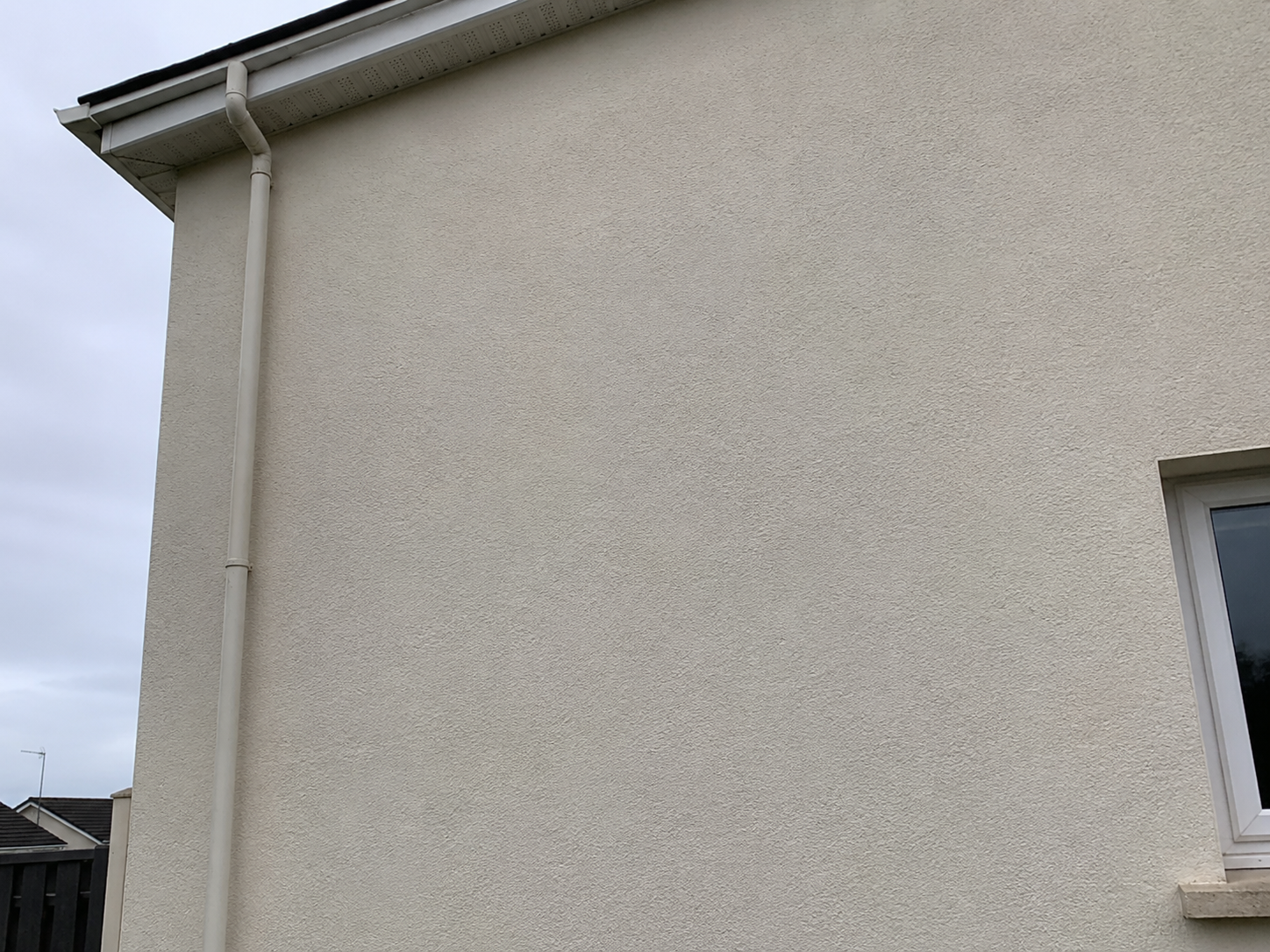
Pressure washing risks damaging render because the force of the water can loosen pebble dash aggregate, drive water behind K-rend, and strip thin layers of a painted or coloured finish. Render is designed to be weatherproof against rain falling naturally, not against a concentrated jet at close range.
Once water gets behind a render finish, it can take a long time to dry out fully, increasing the risk of damp patches appearing on the inside of the wall. Repeated pressure washing over the years tends to leave render looking patchier and thinner than it did originally.
Coastal and exposed sites in County Wexford are particularly affected, since render here is already dealing with more rain and salt-laden air than inland properties. A finish that's been weakened by repeated pressure washing has less resilience against that ongoing exposure.
Does softwashing kill algae spores or just remove visible growth?
Softwashing kills algae, moss and lichen at a biological level, because the biocide treatment works on the organism itself rather than simply dislodging it from the surface. Spores and root-like structures are neutralised during the dwell period, before a gentle rinse clears the residue away.
Pressure washing, by contrast, often leaves spores intact and can spread them further across the wall as the water jet breaks colonies apart. That's a key reason regrowth after a pressure wash tends to be faster than regrowth after a proper softwash treatment.
| Factor | Softwashing | Pressure washing |
|---|---|---|
| Surface risk | Low pressure protects render and pebble dash | Can strip finish and force water behind render |
| Spore kill | Biocide treats algae, moss and lichen at source | Force alone doesn't kill spores |
| Regrowth speed | Slower, since the cause is treated | Often faster, since spores spread and survive |
| Suitable surfaces | Render, pebble dash, K-rend, roof tiles | Hard surfaces such as concrete and paving |
Why does regrowth happen faster after pressure washing?
Regrowth happens faster after pressure washing because fragments of algae and moss, along with their spores, are often driven into the render's texture rather than removed from it. Those fragments can re-establish once the wall is damp again, sometimes within a matter of weeks.
A softwash avoids this by treating the whole colony at a biological level before any rinsing takes place, so there's nothing viable left behind to regrow from the same spot.
This matters most on shaded or north-facing walls, which stay damp for longer between dry spells and offer ideal conditions for algae and moss to re-establish. A wall that's been pressure washed rather than softwashed in this position can show visible regrowth within a single wet season.
When to call a professional
A professional softwash is worth calling in for any render, pebble dash or K-rend wall showing algae, moss or lichen, since these are the surfaces most easily damaged by DIY pressure washing. A biocide treatment reaches growth within the texture of the render that a hose alone can't touch.
Booking softwashing in County Wexford protects the render finish while still clearing every affected elevation of a house. For homes near Gorey and further afield, low-pressure render cleaning can be scheduled alongside gutter or roof work in the same visit.
Frequently asked questions
Can pressure washing be used safely anywhere on a house exterior?
Pressure washing suits hard, sealed surfaces such as concrete paths, block paving and some brickwork, where the force doesn't loosen a finish. It's generally unsuitable for render, pebble dash and K-rend, where the same pressure can strip texture, force water behind the finish and spread algae spores instead of killing them.
Does softwashing take longer than pressure washing?
A softwash usually takes a similar amount of time on site to a pressure wash, since most of the process is the low-pressure application and a dwell period rather than extended scrubbing. The main difference is that regrowth is slower afterwards, because the treatment addresses spores rather than just visible growth.
Will softwashing remove existing render stains immediately?
Softwashing lifts organic growth such as algae, lichen and moss, and general staining caused by that growth usually fades as the treatment takes effect. Stains from other sources, such as rust or paint, aren't addressed by a biocide softwash and would need a separate, targeted approach.
Is softwashing suitable for painted render as well as bare render?
Yes, softwashing is generally suitable for painted render, since the low pressure and biocide treatment work on the organic growth sitting on the surface rather than stripping the paint itself. Older or already-peeling paintwork is treated with extra care to avoid disturbing loose sections.